Your data is holding your AI back
Pod-OS is a time-aware, distributed multigraph database: claim-level Event Objects carrying embeddings, typed fields, and validity intervals, connected by weighted bi-directional Links. Joins, aggregation, and conflict detection execute in the store; the model receives a projection sized to the decision.
“Pod-OS allows us to process billions of data points with sophisticated AI in seconds. We can tackle fundamentally bigger problems.”
- 95% of enterprise AI pilots fail to deliver measurable business impact [Fortune & MIT]
- $406M average annual loss per company from poor data quality in AI [Business Wire & Fivetran]
- 42% of companies abandoned most AI initiatives in 2025 [S&P Global]
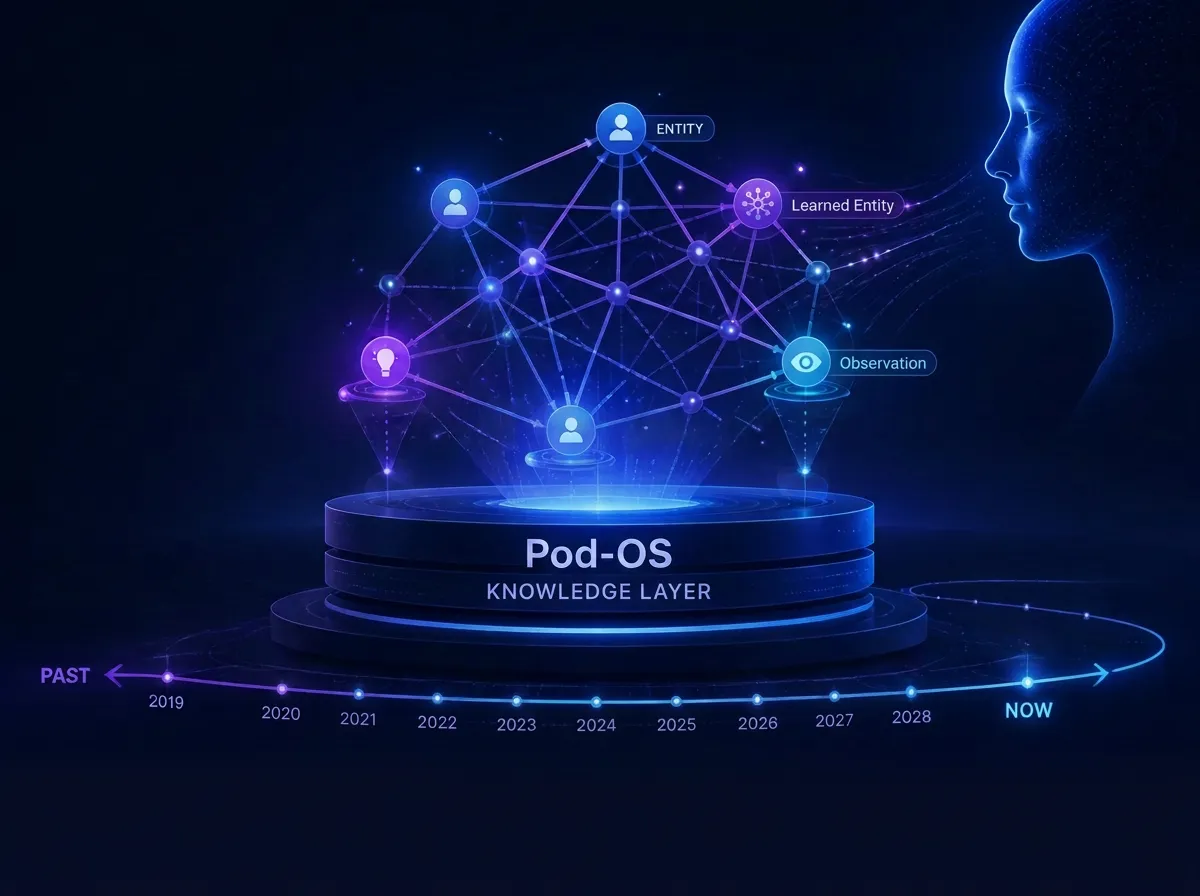
Resolution
The loss happens at ingest.
Resolution is the finest grain at which a fact is independently addressable, attributable, and timestamped.
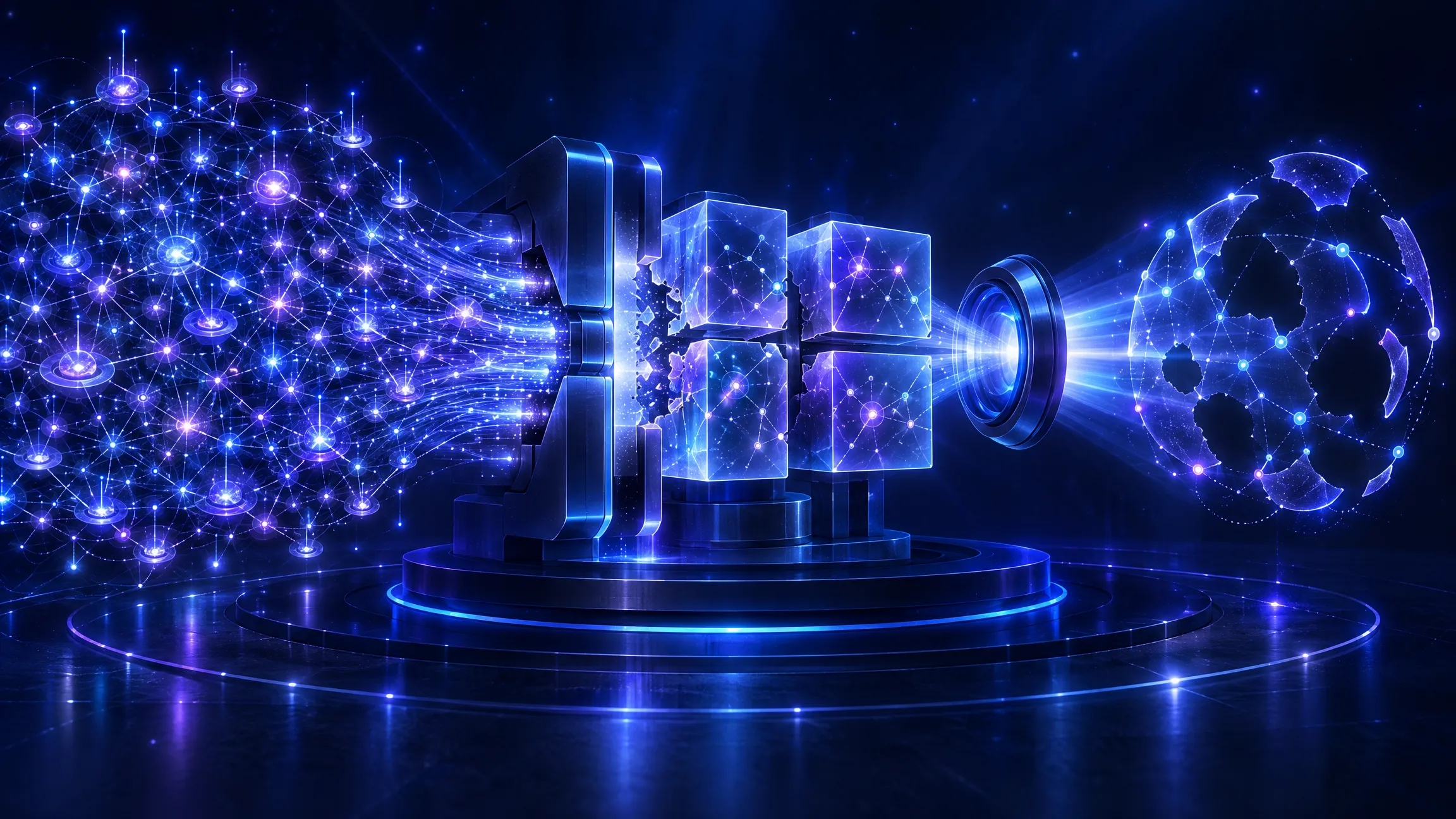
A document is coarse. A chunk is coarser in the way that matters, because a chunk is an arbitrary cut made by a splitter that had no knowledge of the question it would later have to answer. Once you chunk, you have quantized — before the query exists. Every retrieval after that is a search over a lossy encoding whose loss function was chosen by a text splitter.
No amount of retrieval sophistication recovers what was destroyed at ingest.
Classification
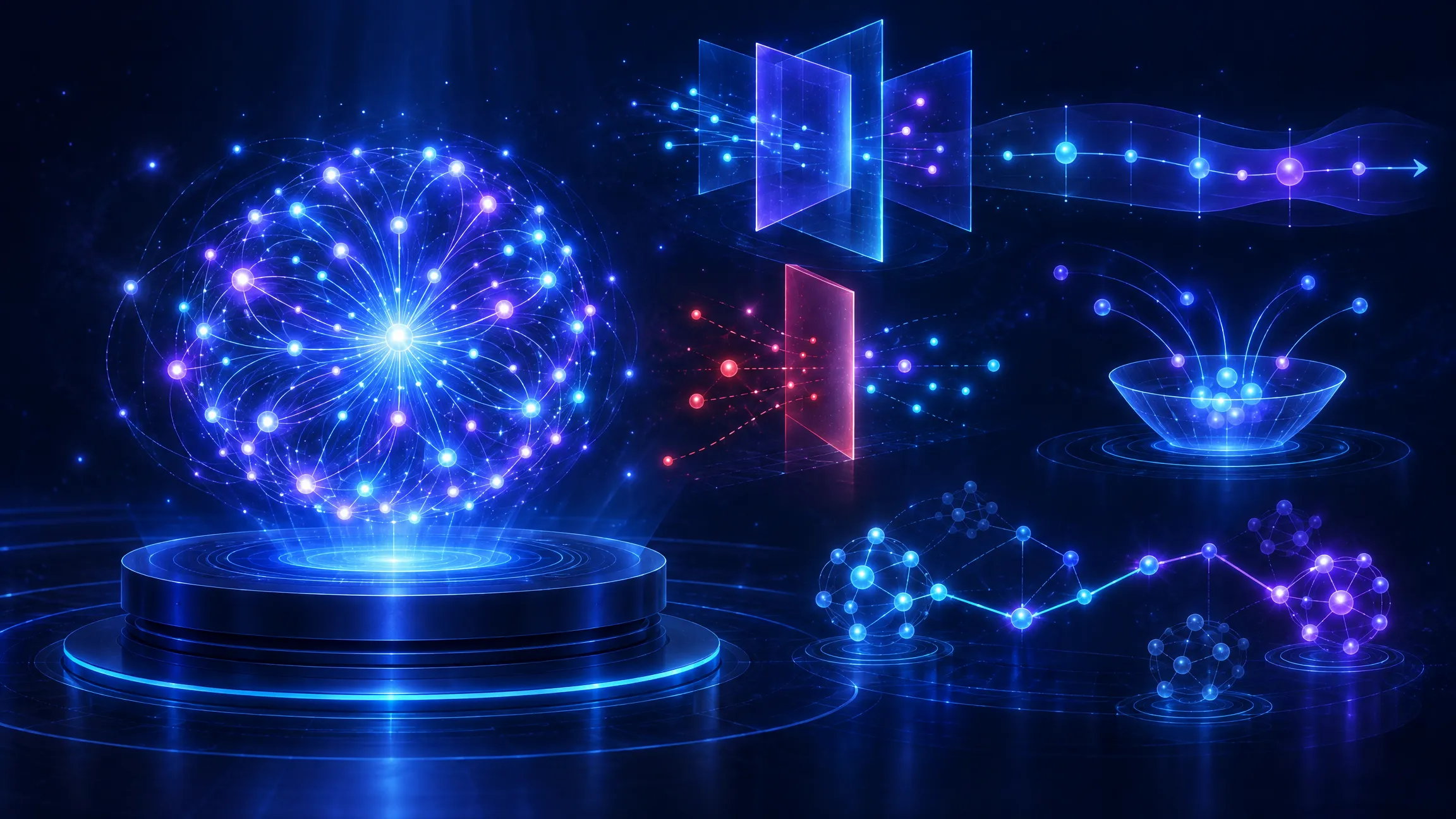
Untyped text supports exactly two operators: similarity or exact match.
Boolean composition, range filters, as-of predicates, negation, aggregation, graph traversal, join — none of them exist in that representation. It isn't that similarity is bad. It's that similarity is a single operator over an unclassified space, and most real decisions are conjunctive, temporal, or relational.
The corollary: classification creates the value, and it happens at ingest and at query time. A store that executes rich queries over poorly classified content is a fast path to a wrong answer.
The technique table
What each technique actually moves.
| Technique | Moves | Does not move |
|---|---|---|
| Prompt engineering | Encoding alignment | Which facts are available |
| Document retrieval | Availability; distractor mass | Resolution or classification |
| Fine-tuning | Priors, format, domain register | Facts that change after the run; auditability |
| Data scaling | Coverage | Precision; past a point, adds distractors faster than signal |
Only one row touches encoding. Only one touches availability. None touches resolution or classification — both are fixed upstream at ingest.
Every inference-time technique operates downstream of a loss that already occurred.
Natural widths
A bigger context window doesn't fix this.
Every decision has an intrinsic width — the minimum information needed to make it.
Context windows are constant. Decision widths are not.
The target isn't a bigger window. It's a retrieval layer whose returned width tracks the decision.
Intrinsic decision width
- Recall question
- ~200 tokens
- Change detection
- 2 claims · 2 times · 2 sources
A single asserted fact is enough.
Two claims about the same entity at two different times plus their sources — irreducible. No number of tokens that omits either can answer it.
Too much context — The surplus is distractor mass.
Too little context — The model fails confidently, because it has no representation of what it wasn't given.
One record
AI needs three kinds of data. You're running three databases to get them.
- Mathematical — embeddings and vectors, for similarity.
- Relational — facts, entities, and how they connect.
- Temporal — when something was true, and what it replaced.
Today that means a vector store, a graph or relational database, and some bolted-on versioning, glued together and kept in sync.
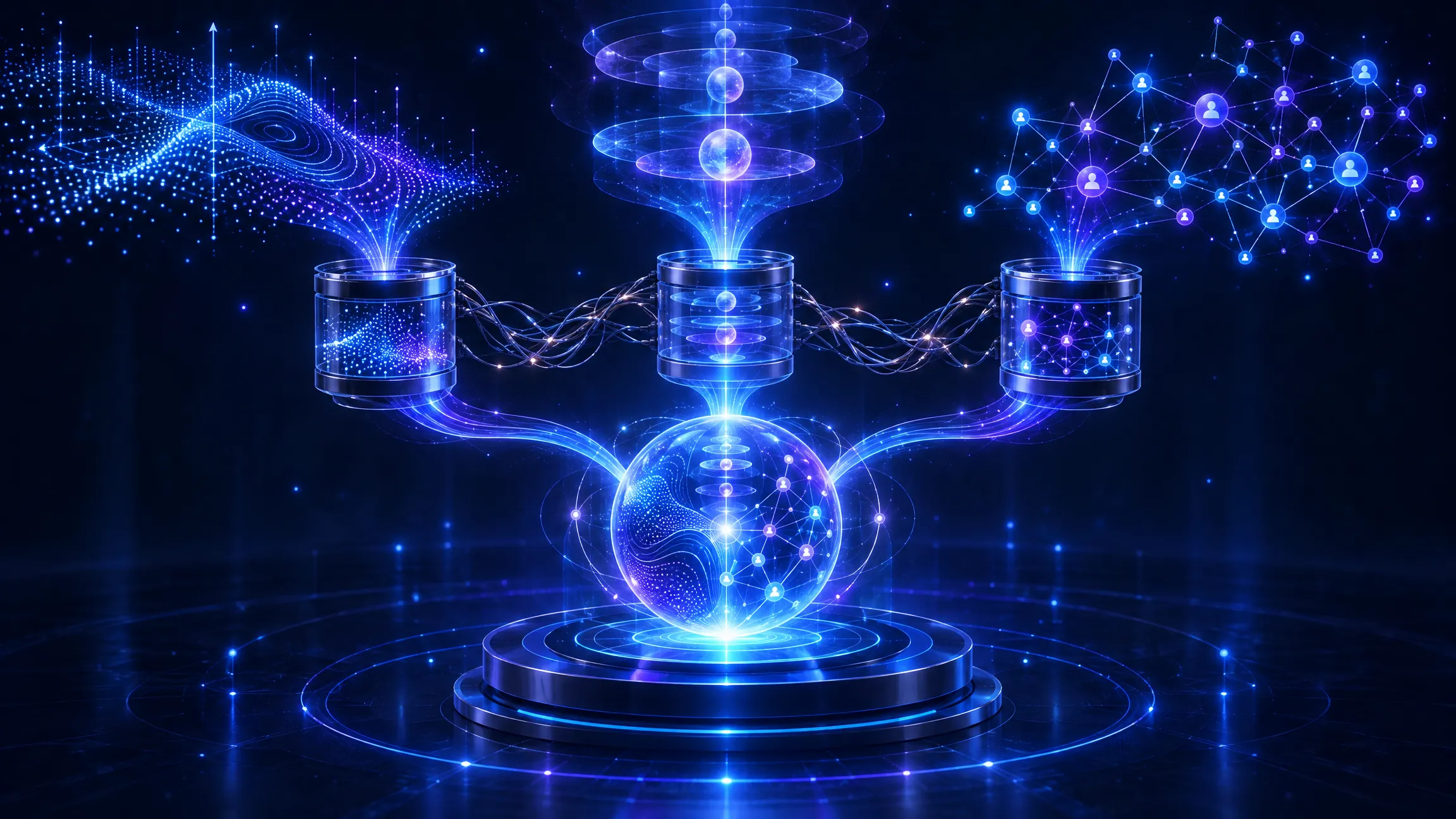
Pod-OS holds all three in one record.
The Event Object
How it works.
Pod-OS is a time-aware, distributed multigraph database. Every node is an Event Object — one asserted claim carrying its embedding, its typed fields, its validity interval, its source, and its confidence. Tags describe Event Objects. Bi-directional Links connect them, so relationships are traversable from either end. Nothing is overwritten: a change is a new assertion with its own time and source.
Because facts are typed and timestamped at claim level, Pod-OS answers questions a similarity or keyword search cannot express — as-of state, what changed between two dates, contradictions between sources, and what is missing.
SDK surface
Assert claims, tag them, link them, and query as-of state directly from your language of choice. Open-source clients on GitHub; Cursor IDE integration ships with the free tier.
Browse SDKs and CLI →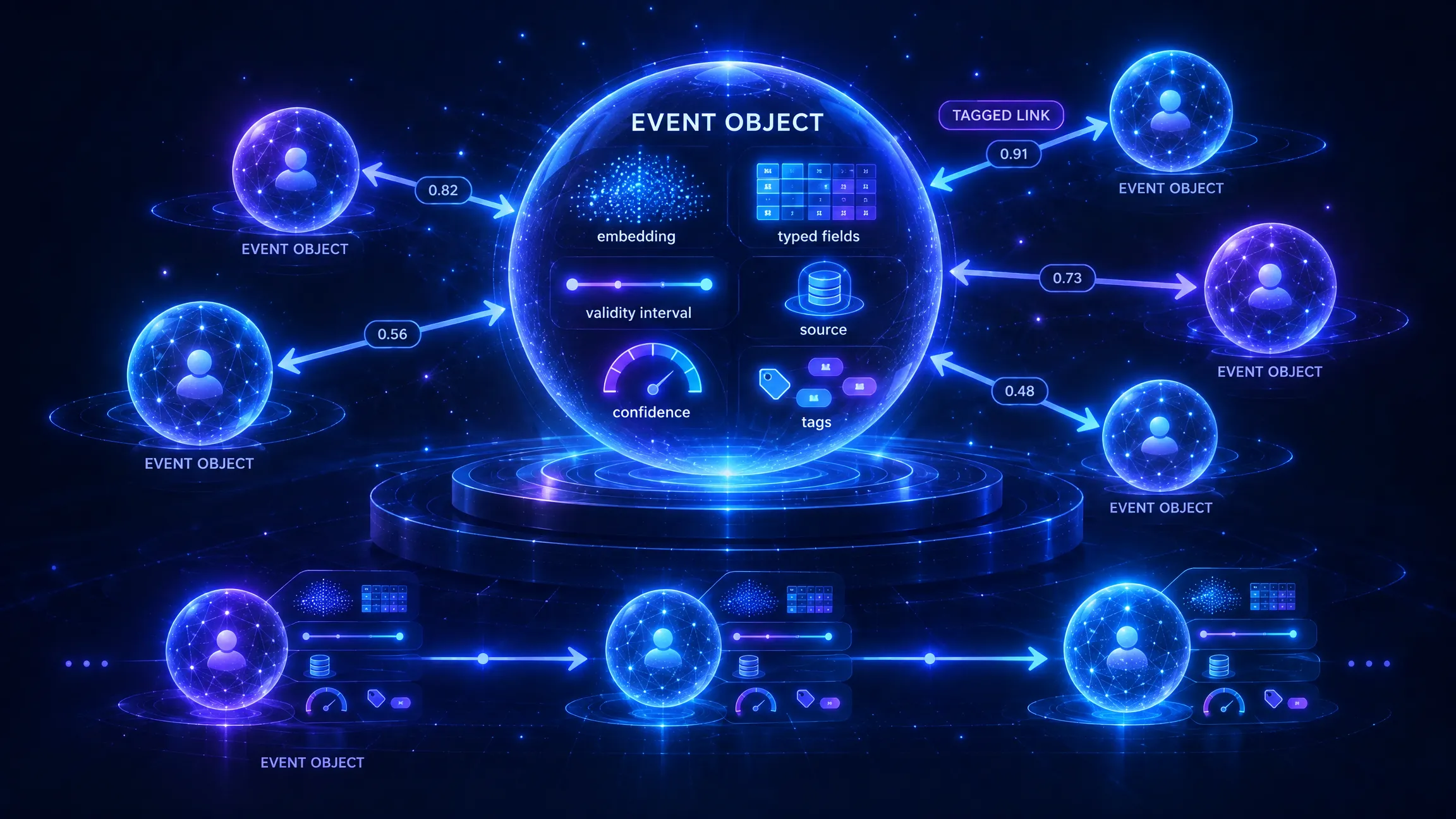
Developer Tools
Public SDKs and CLI
Open-source clients for the Pod-OS Actor Network and Evolutionary Neural Memory. Install from GitHub and start sending AIP messages against a live gateway.
Python Client
Async AIP client for Actor registration, messaging, and Evolutionary Neural Memory operations.
pip install pod-os-py-client
View on GitHub →
Rust Client
High-performance Rust crate for Pod-OS Actor networks, with GenAI development prompts.
pod-os-client = { git = "https://github.com/PointOfData/pod-os-rust-client" }
View on GitHub →
Go Client
Go module for AIP messaging and Neural Memory intents against live Actor gateways.
go get github.com/PointOfData/pod-os-go-client
View on GitHub →
Java Client
Java library for performant access to the Pod-OS Actor Network and ENM operations.
com.pointofdata:pod-os-java-client (see GitHub for Maven setup)
View on GitHub →
podos CLI
Command-line client for exercising live Gateways and Actors over raw AIP TCP sockets.
cargo install --git https://github.com/PointOfData/podos-cli --tag v0.1.0
View on GitHub →
Expressible queries
Proof.
Ask a vector database what a policy said as of February 2024, what changed since, and which source superseded it.
It can't rank for that — the predicates don't exist in the representation. Pod-OS answers it in one query.
What did the Remote Work Policy say as of February 2024, what changed since, and which source superseded it?
Vector database
similarity onlyPod-OS
GET STARTED
5 Minutes to Your First Evolutionary Neural Memory
Sign up for the free Explore tier
Launch an Evolutionary Neural Memory instance
Load data via a public SDK (Python, Rust, Go, or Java), pre-prepared datasets, or the Knowledge Hypergraph Generation toolset
Query with programmable compound search
Cursor IDE integration. LLM-powered prompting. Support Agent for bug resolution within 5 minutes.
Spotlight Client
MS Orchestra
"Pod-OS allows us to ply billions of data points with sophisticated AI in seconds. By opening up broader horizons of scale and speed, we can apply more math to more data per microsecond, and tackle fundamentally bigger problems."
Matt Rain - President, MS Orchestra
TEAM
Built by People Who've Shipped AI at Scale
Chris Schindler
CEO
25+ years, 11+ patents. Alexa AI, Microsoft Speech Server → billions of users.
Mike Meadway
CRO & Co-Founder
10+ patents in DB + encryption. Built the core platform.
Stanford Tharp
Chairman & Co-Founder
Recognized the context revolution 20 years early. Started building.
Two Ways In
Request a Beta
Free tier. 5-minute setup. Public Python, Rust, Go, and Java SDKs.
Browse SDKs and CLI · Docs hub
Let's Talk
$122B market. 10 years of R&D. Ready to deploy.