Your data is holding your AI back
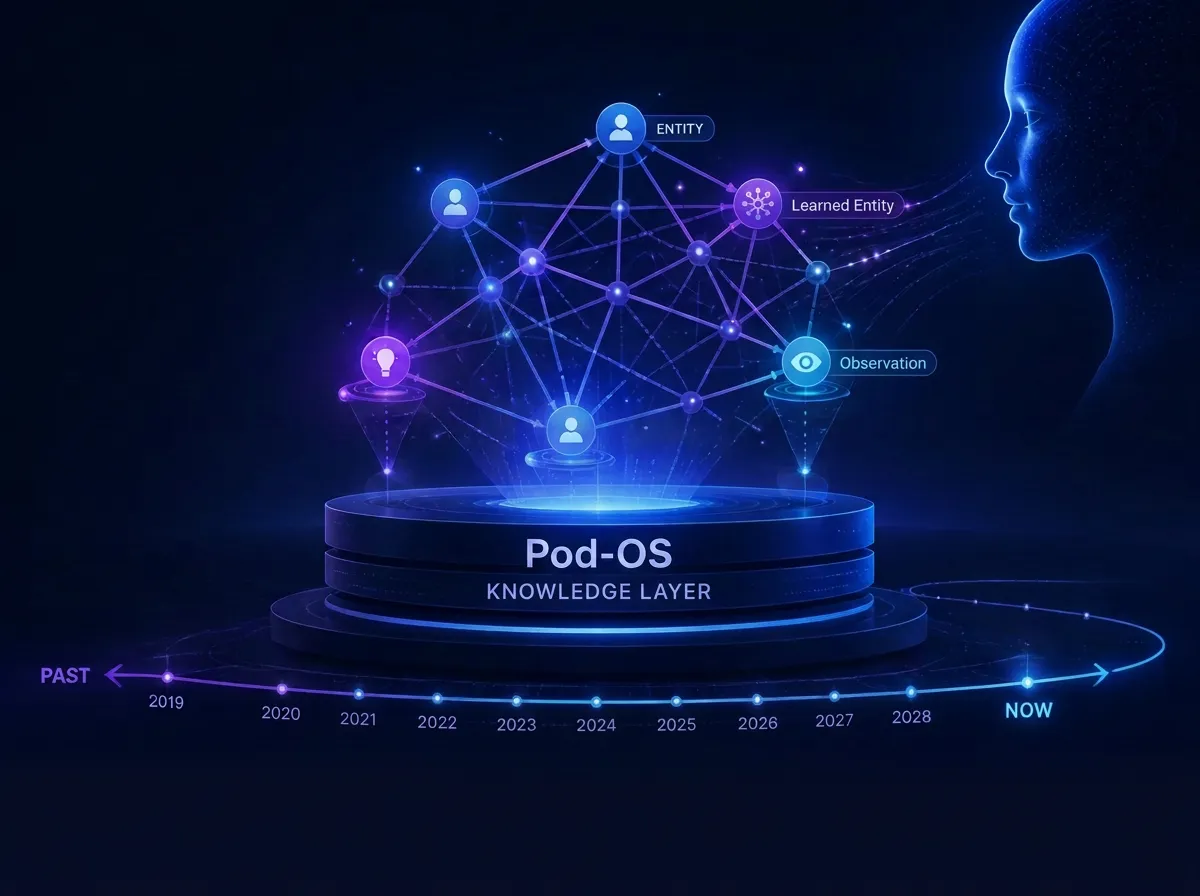
Most AI projects fail on data, not models. The facts are scattered, stripped of when they were true, and frozen on the last version. Pod-OS is memory for that record: where each fact came from, what it connects to, and what it replaced. Answers are the right information at the right moment, not a confident guess from scraps.
“Pod-OS allows us to process billions of data points with sophisticated AI in seconds. We can tackle fundamentally bigger problems.”
- 95% of enterprise AI pilots fail to deliver measurable business impact [Fortune & MIT]
- $406M average annual loss per company from poor data quality in AI [Business Wire & Fivetran]
- 42% of companies abandoned most AI initiatives in 2025 [S&P Global]
The problem
The problem, in plain terms
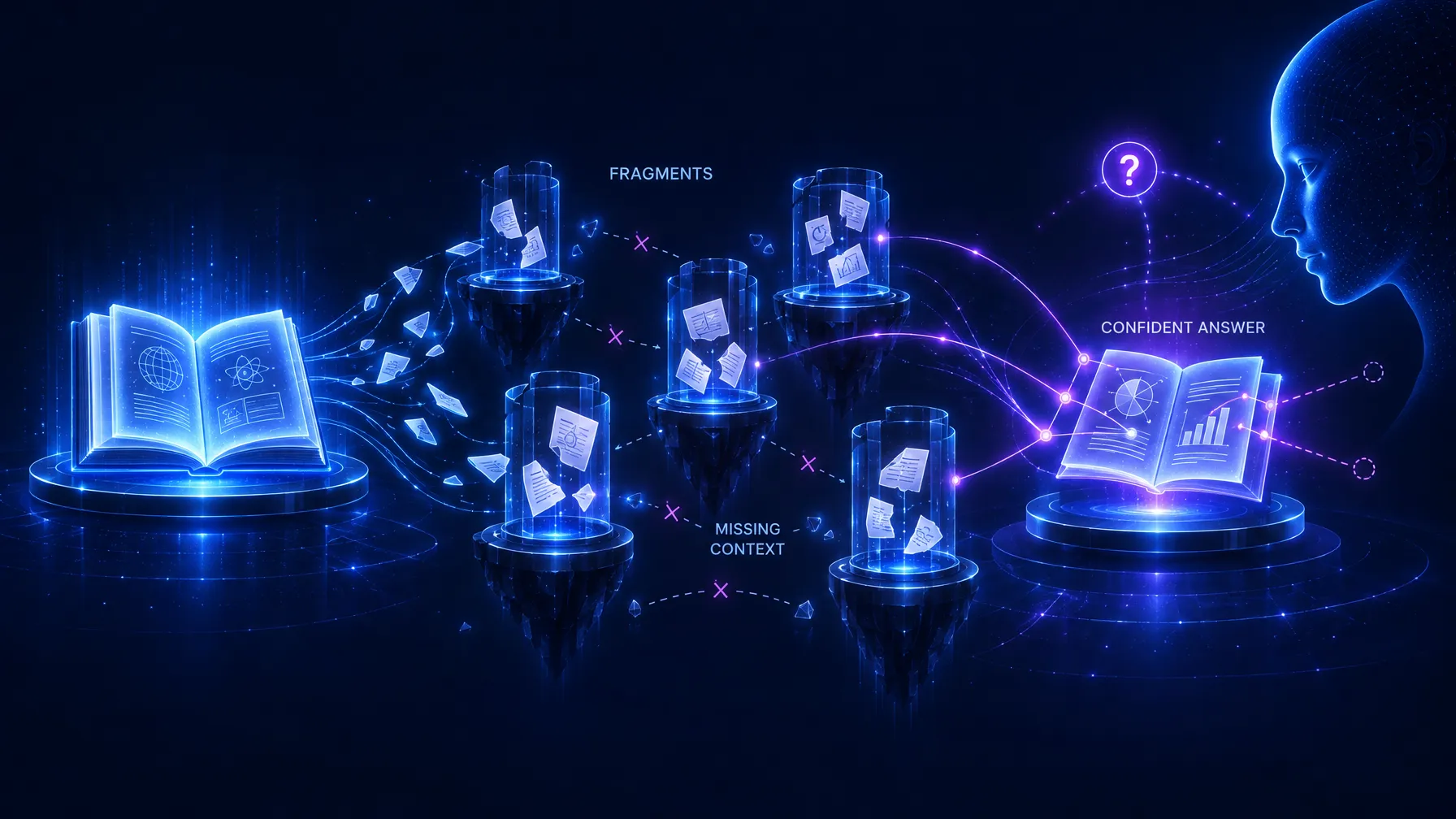
Today's databases store information the way you'd store a book by putting each page in a different building — and cutting the pages up first, before anyone asked a question.
The cuts were made by software that didn't know what you'd need. So when AI goes looking, it finds fragments with no history and no connections. It fills the gaps. And it sounds completely confident while doing it.
A better way
What it means to remember properly
Memory is not storage. A record that remembers properly keeps the connections between facts, the history of how they changed, and enough structure to answer questions nobody anticipated when the data arrived.
Everything connected
One question pulls the complete picture, not fragments.
Change becomes knowledge
Like an edit history for all your business data: what changed, when, and why it matters.
Search that finds patterns
Instead of "find me files about Q3 sales," ask "what changed in our top accounts' behaviour before they churned?"
One record
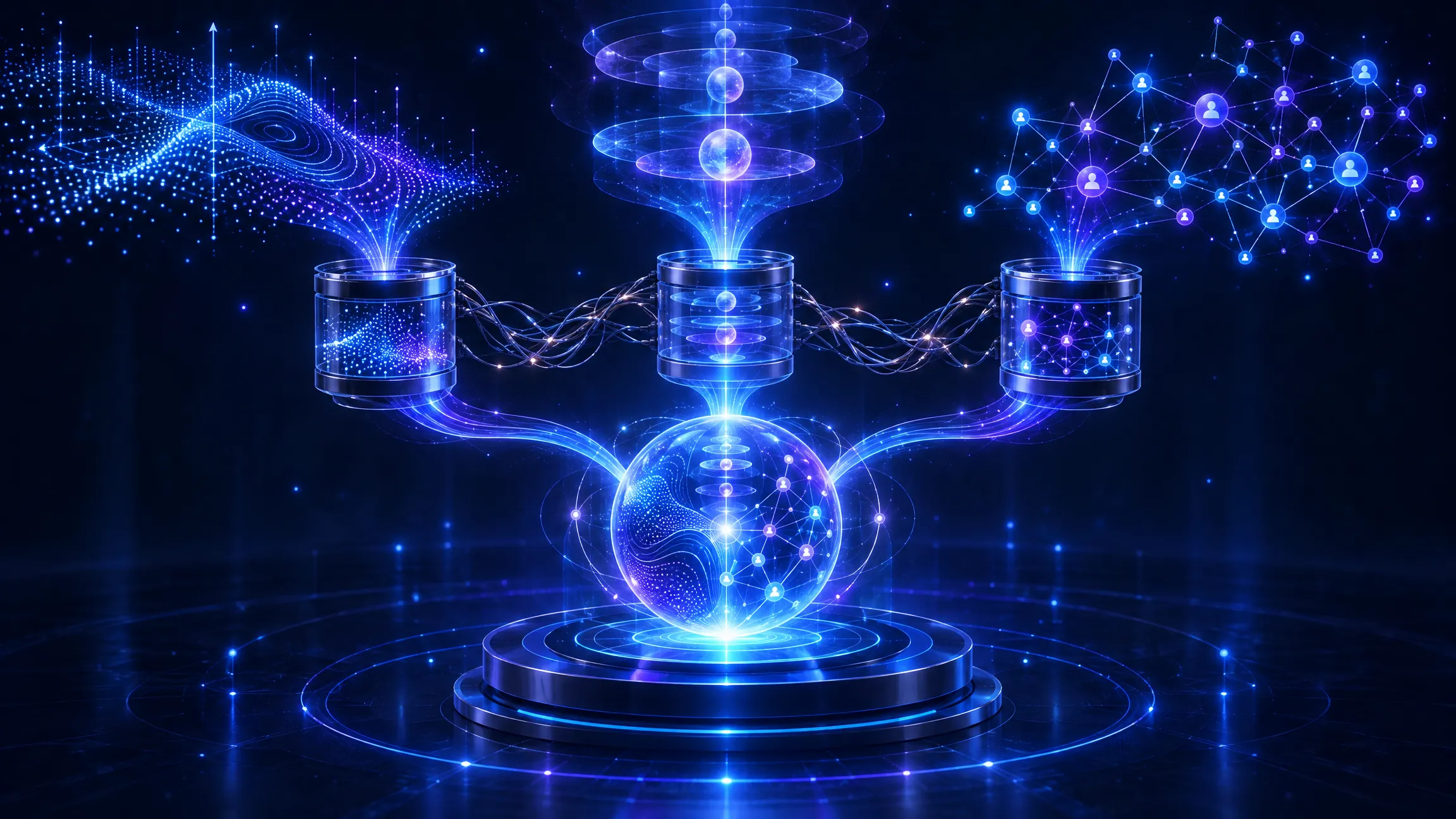
AI needs three kinds of data. You're running three databases to get them.
- Mathematical — embeddings and vectors, for similarity.
- Relational — facts, entities, and how they connect.
- Temporal — when something was true, and what it replaced.
Today that means a vector store, a graph or relational database, and some bolted-on versioning, glued together and kept in sync.
Pod-OS holds all three in one record.
We can replace your fragmented databases or sit next to them leveraging their data as diverse, structured sources.
How it works
Every fact is an Event Object
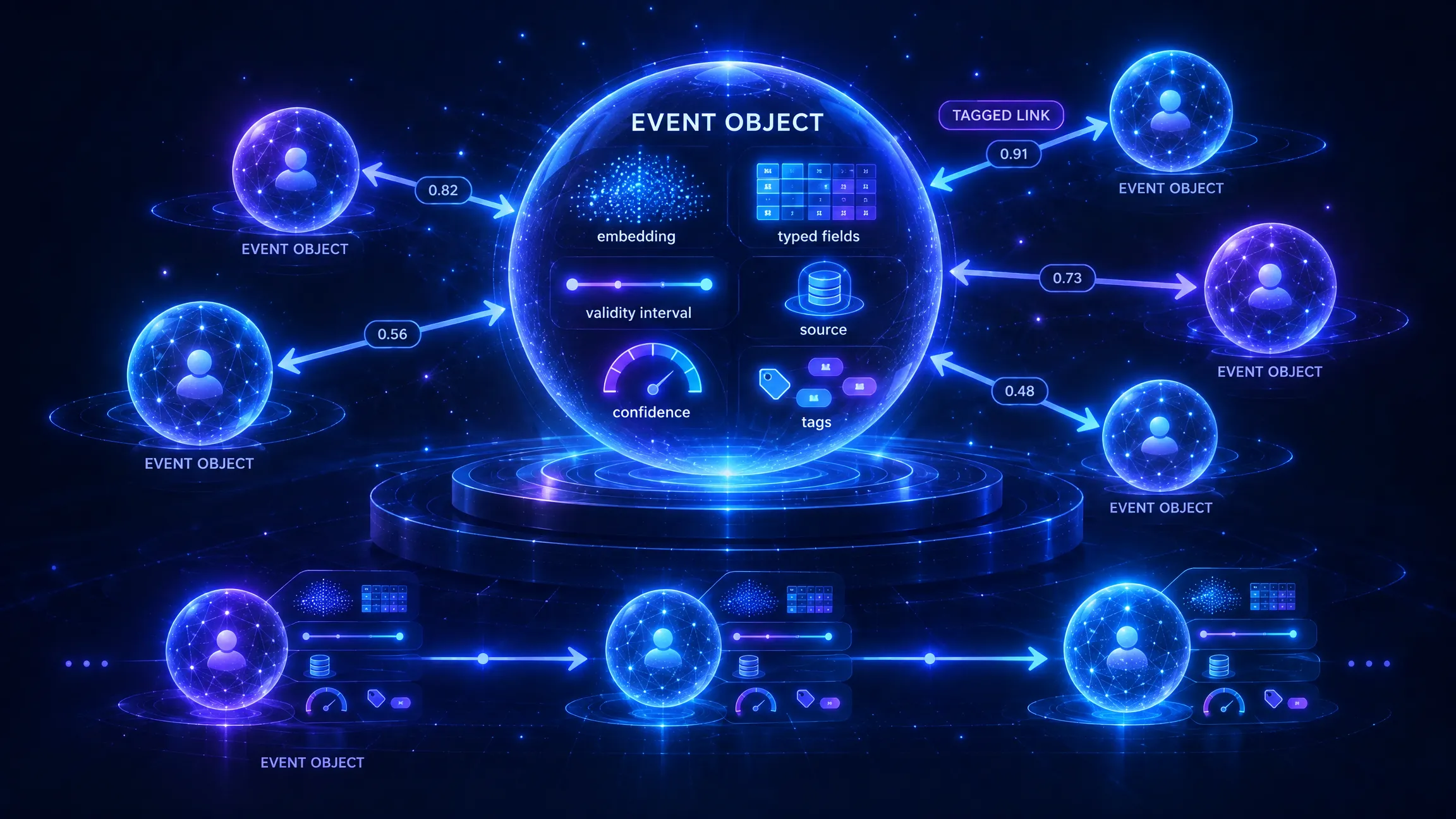
Pod-OS is a time-aware, distributed database — a single connected map. Every node is an Event Object — a document, a passage, a measurement, an event, or a claim carrying its time, location, embedding, its typed fields, its validity interval, its source, and its confidence. Tags describe Event Objects. Bi-directional Links connect them, so relationships are traversable from either end. Nothing is overwritten: a change is a new assertion with its own time and source.
Because facts are typed and timestamped at claim level, Pod-OS answers questions a similarity or keyword search cannot express — as-of state, what changed between two dates, contradictions between sources, and what is missing.
Expressibility
What becomes possible
Questions the old stack cannot answer — because the connections, history, and context were never in one place. These are not faster versions of existing queries. They are queries the previous representation could not express at all.
“How has our approach to this customer changed over the last two years?”
Instead of searching through dozens of disconnected documents, the system traces the full history — every meeting, decision, and shift — and delivers a complete answer in seconds.
“What happened in the six months before this patient's cardiac event?”
The system pulls together medications, symptoms, lifestyle changes, and family history — all connected, all in context. Not just data points, but a story.
“When a port closes overseas, which routes rebalance — and what breaks next?”
Instead of waiting for reports and manual intervention, the system's components immediately recognize the disruption, simulate alternative routes, and begin rebalancing — autonomously, in minutes instead of days.
Timing
Why this moment
“The next decade of AI will be won by organizations that make their data durable, searchable, secure, and efficient — not by adding more layers on top of yesterday's infrastructure.”
The AI revolution created urgent need
Enterprise AI spend is surging, but most organizations still run on data infrastructure built for a different era. In a 2024 survey of 550 companies with 500+ employees (U.S., U.K., Ireland, France, and Germany), respondents estimated that underperforming AI models — driven by poor data quality — cost the average firm about $406 million in annual revenue, roughly 6% of revenue among companies averaging $5.6 billion.
The real world is too complex for old filing systems
Supply chains, patient records, financial networks, climate data — the problems AI needs to solve are deeply interconnected. You can't solve connected problems with disconnected data.
The opportunity
A $122 Billion Market by 2030
Data practices are already the clearest dividing line in enterprise performance — and AI is about to widen it.
The companies that get data right will win the AI era. We’re building the infrastructure that makes "getting data right" possible.
Fortune 500 companies with advanced data practices
- 5×
- revenue growth
- 89%
- higher profits
- 2.5×
- higher valuations
Compared with peers. Source: ZoomInfo
Why us
10 Years of Building. Ready to Deploy.
This is not a research prototype. The architecture has been in development for a decade, and it is running production workloads.
- 21+ patents across databases, machine learning, and AI
- Technology built by team members who helped create Alexa AI, Microsoft Speech Server, and other products used by millions
- 10+ years of R&D in the underlying architecture
TEAM
Built by People Who've Done This Before
Chris Schindler
CEO
25+ years leading AI teams at Microsoft, Amazon, and SoundHound. Helped build products like Alexa AI that serve billions of people. Patents in machine learning and AI.
Mike Meadway
Chief Research Officer & Co-Founder
The inventor behind the platform. 10+ patents in databases and encryption. Serial entrepreneur with deep expertise in how data systems actually work.
Stanford Tharp
Chairman & Co-Founder
Recognized 20 years ago that AI would need high-fidelity context to reach its potential — and started building toward it.
Open source SDKs
Build on Pod-OS
Public clients for Python, Rust, Go, and Java — plus a CLI for live gateway testing. Assert claims, link them, and query as-of state from your language of choice.
View all developer tools →Ready to See What Better Data Can Do?
Explore the Platform
Free access for builders. Set up in under 5 minutes.
Talk to Us
For investors, partners, and enterprise teams exploring AI infrastructure.